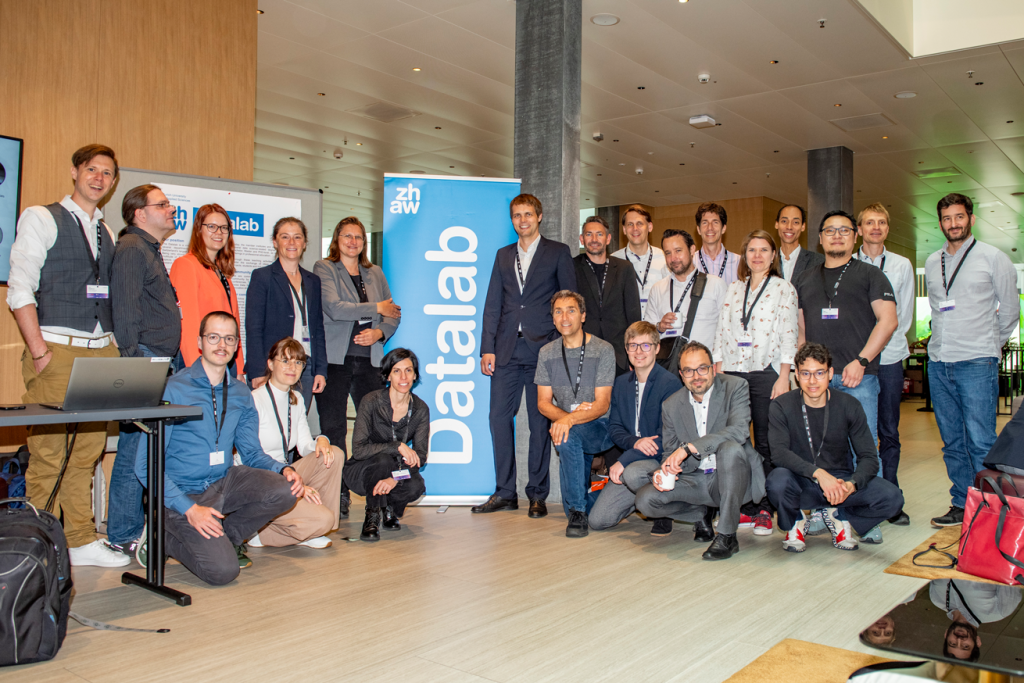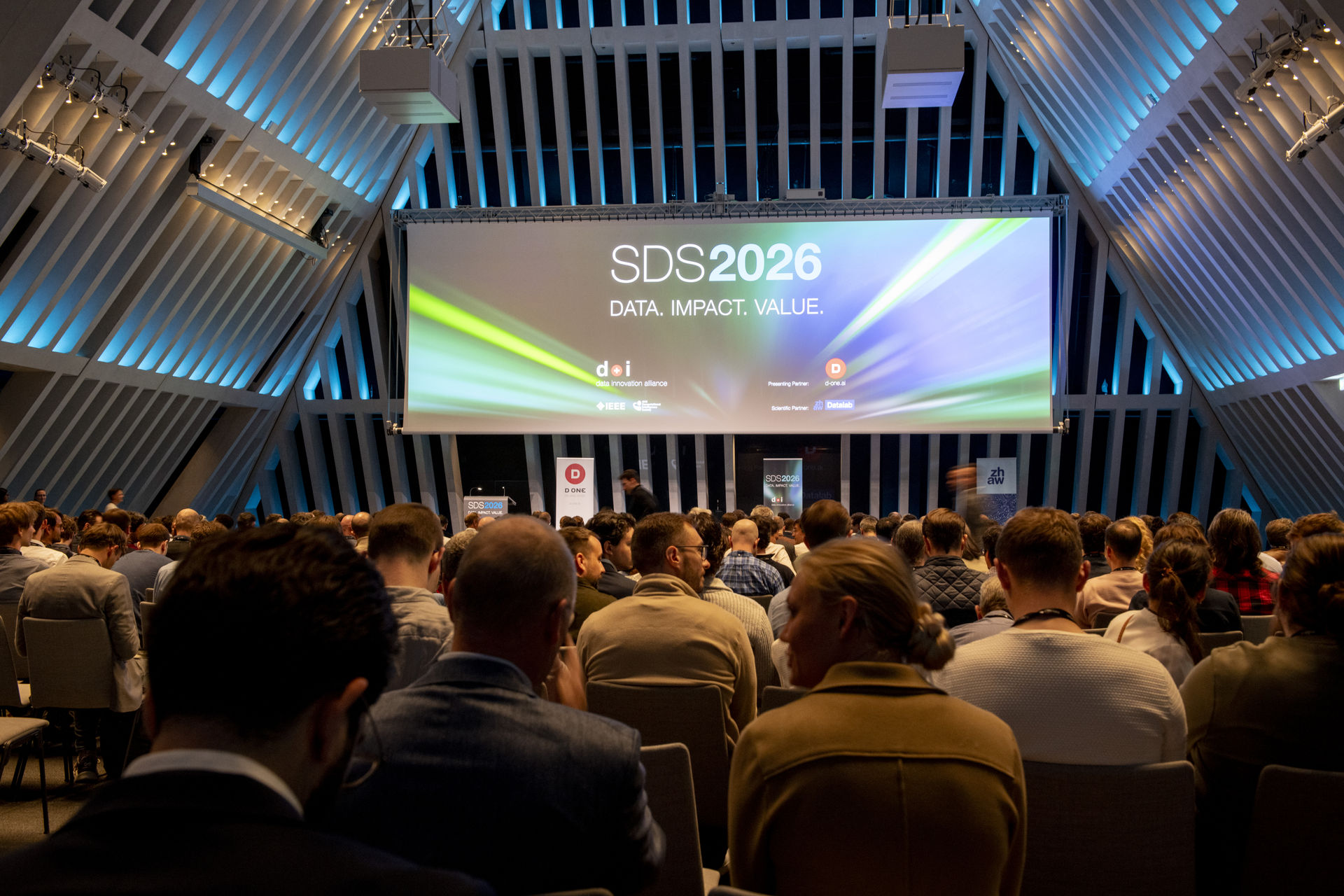
The SDS is a place where data scientists and industry actors convene. ZHAW is the conference’s long-standing scientific partner, and this year’s contributions showed once again how much value ZHAW projects can bring when theory meets real-world needs.
What can batteries teach us about monitoring? How does a cost-optimal human-AI workflow look? How can AI systems cope with complex documents? And how can we leverage AI tools to better defend against AI attacks? These questions were explored in several ZHAW projects.
How Much Data Is Enough? What Battery Systems Teach Us About Monitoring
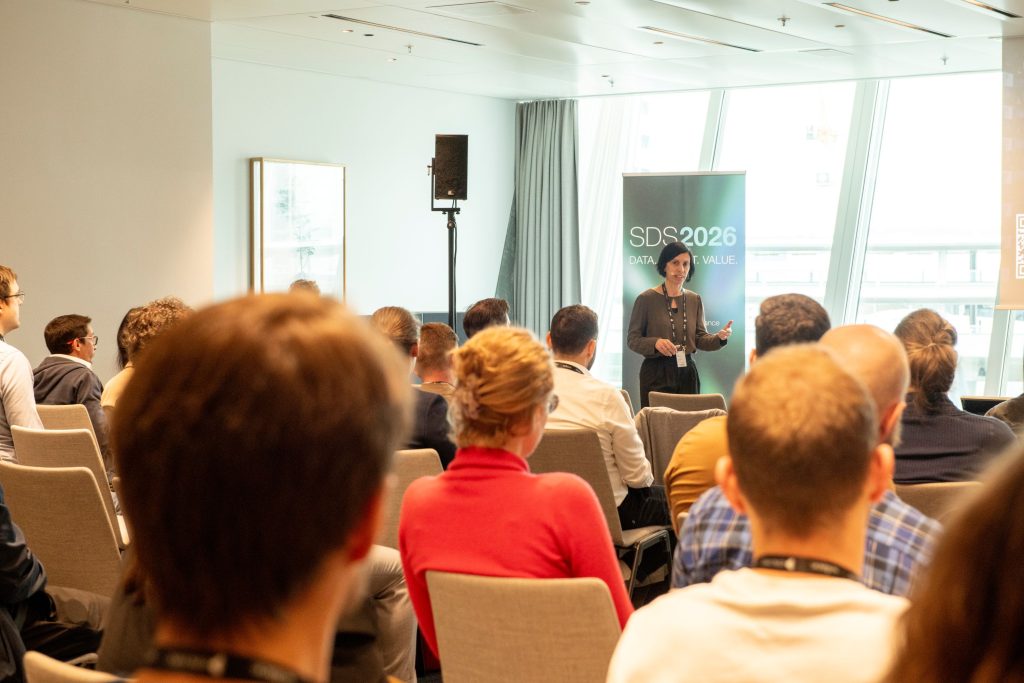
As sensor-rich systems become prevalent, we face a growing tension: more data improves monitoring, but comes at increasing cost in storage, communication, and computation. This trade-off is common in many critical applications, including power grids, manufacturing lines, transportation networks, water systems, cellular infrastructure, and environmental monitoring.
Lilach Goren Huber, together with Matthias Wüest and Antoni Plonczak, analysed this trade-off by monitoring the health of safety-critical battery systems. High-resolution data improves detectability, debugging, and fidelity, but lower-resolution data can be cheaper, faster to process, and easier to scale. Their work suggests that the question is not simply whether more data is useful, but when it is worth the cost.
The team compared classical methods and deep learning across different levels of granularity and found that anomalies can often be detected reliably even without the most detailed measurements. A physics-informed hybrid approach appears especially promising, combining the strengths of domain knowledge and machine learning.
Designing Cost-Optimal Human-AI Workflows
65% of companies adopt AI, but only a small fraction can generate value, as AI comes with risks safety hazards and financial losses – requiring a human safety net.
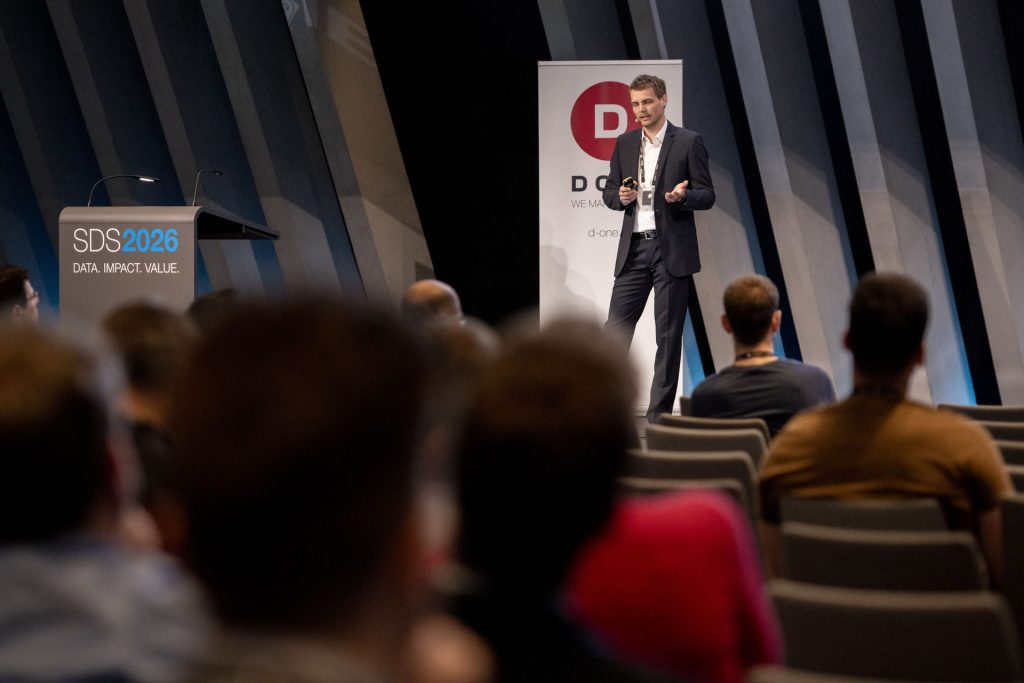
For the first time, Manuel Dömer, together with Jochen Wulf and Jürg Meierhofer, developed an analytical framework for retrieval-augmented generation that makes this trade-off measurable. The framework considers the AI infrastructure cost, human labor cost, and error cost.
Their industrial case study in Swiss manufacturing showed that the best setup is not always the most automated one. In their customer service example, a human-in-the-loop workflow outperformed other configurations because it balanced efficiency with reliability. The study also highlighted that AI accuracy, retrieval success, and the AI evaluator are among the strongest cost drivers.
From Document Recognition to Pro-Human AI
Thilo Stadelmann explored the breaking points of AI in complex use cases, as well as the influence of AI usage on humans.
In complex documents such as engineering drawings and formulas, traditional OCR-style methods often break down. A key method is to move beyond partial recognition toward full document transcription, treating documents as structured information rather than simple images. The first end-to-end results in transcribing complex technical documents show promising progress.
Looking beyond technical performance, the talk also asked what happens when AI systems affect human well-being. According to Stadelmann, a “pro-human” design can preserve connectedness, autonomy, agency, embodiment, and meaning. This idea was illustrated with a psychiatry use case, where AI supported doctors in writing session reports.
Defending Against AI Attacks
In cybersecurity, the challenge is not only to detect attacks, but to understand them quickly enough to respond. Philipp Denzel’s talk on intrusion detection emphasized that analysts need explanations, not just alerts.
The work explored both intrinsic and post-hoc explainability methods for anomaly detection, showing how they can help analysts trace suspicious events back to their root causes. This kind of explainability supports temporal localization, feature-level audit trails, and better model validation, all of which are crucial in a domain where false positives and missed detections both carry real costs.
Poster and Robot Highlights
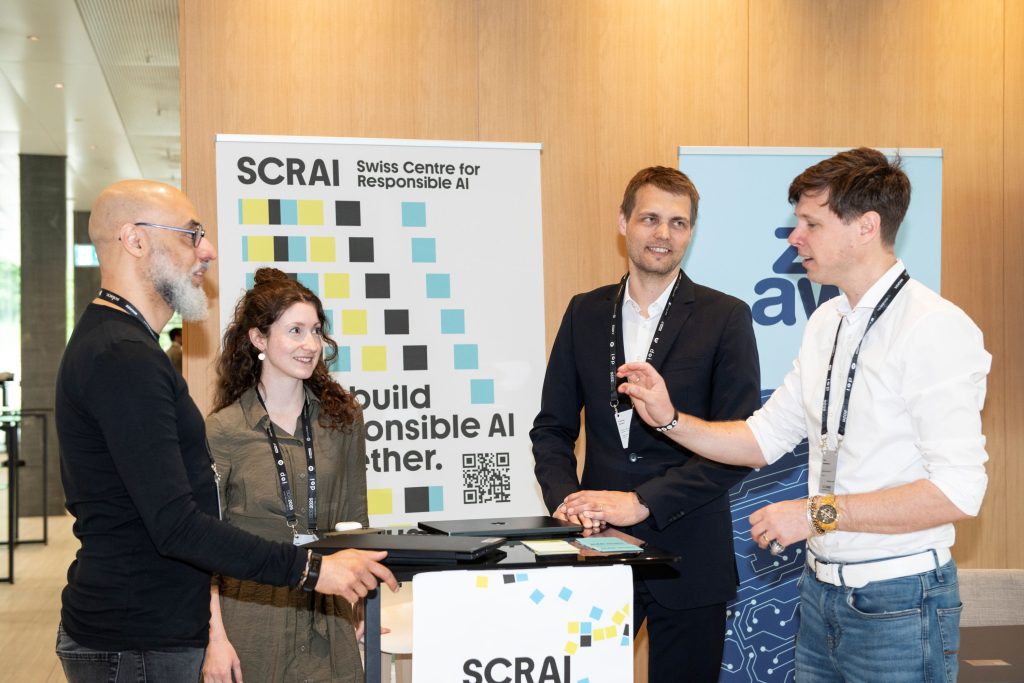
Beyond the talks, the poster discussions with Pavel Sulimov, Jasmin Heierli, Claude Lehmann, and others highlighted additional ZHAW projects at the intersection of applied AI, safety, climate, and privacy. One poster explored predictive anomaly detection in vehicles using sensor data and temporal convolutional networks. Other posters focused on flood detection with Sentinel-2 satellite imagery and privacy-preserving machine learning.
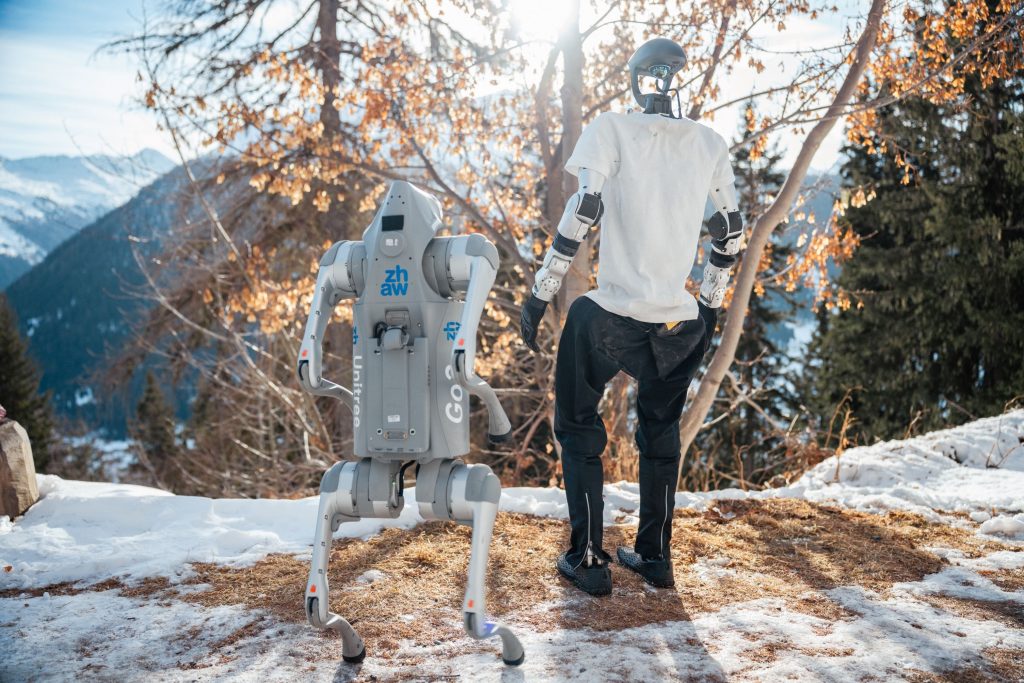
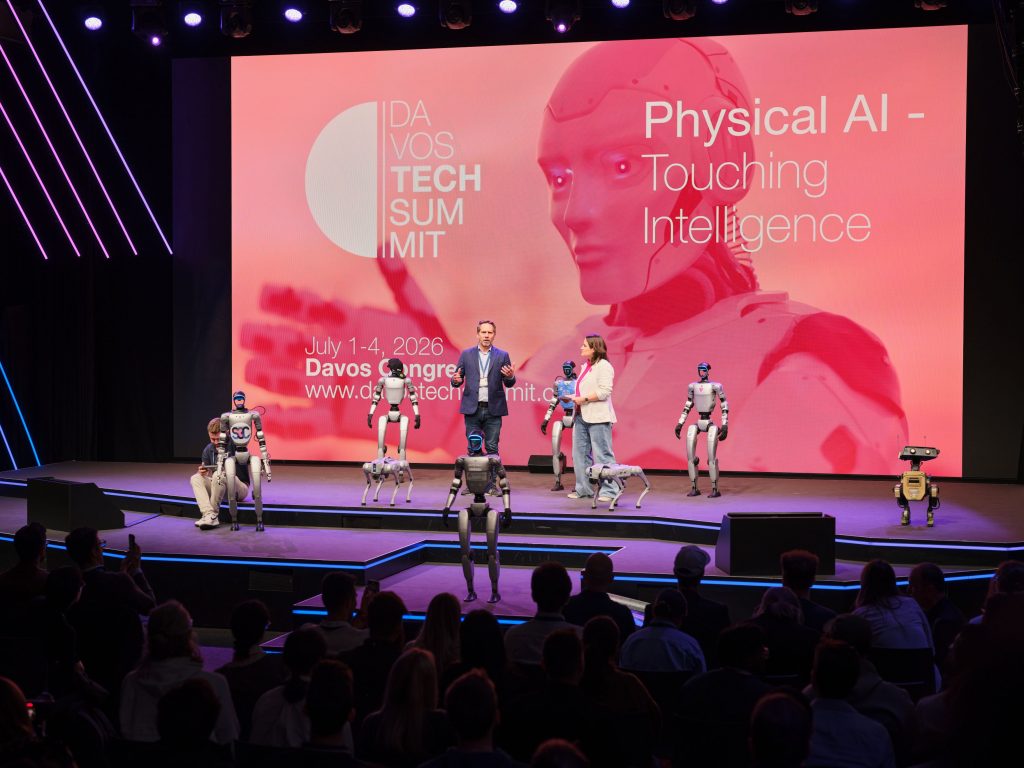
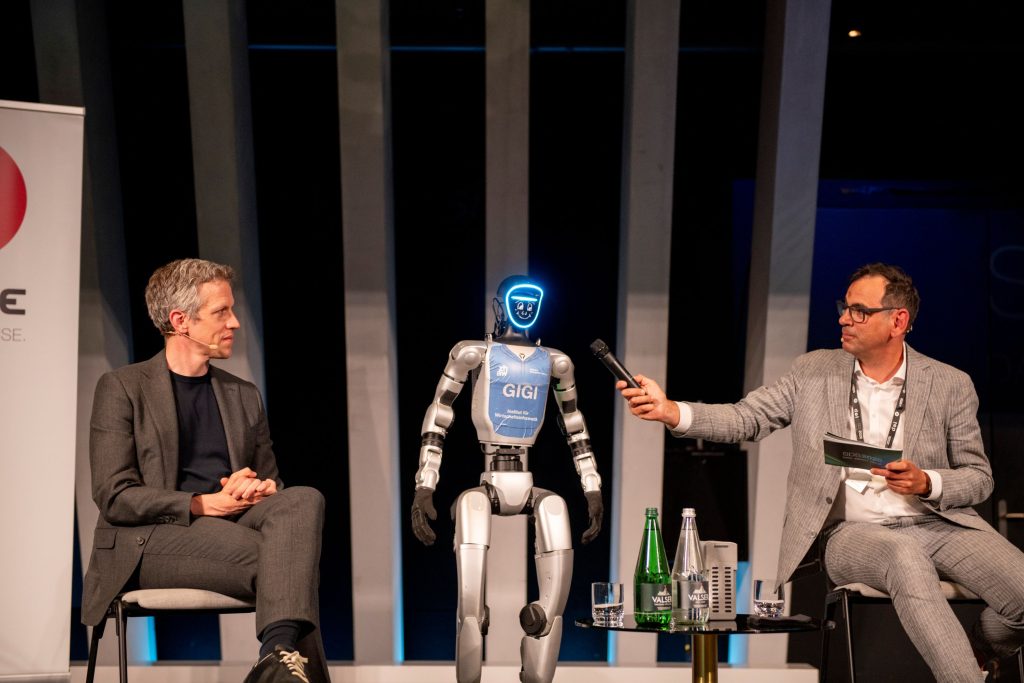
And then there was a special guest on stage: the humanoid robot GIGI joined the panel discussion on physical AI. Pre-programmed by Theresa Schmiedel’s team, it added a memorable perspective on the future of robotics and helped promote the Davos Tech Summit, a major robotics event this summer that ZHAW co-initiated.
A Shared Pattern
Across these projects, a common theme emerged: the most valuable AI systems are not necessarily the biggest or most automated ones. They are the ones that fit the task, respect real constraints, and make good use of human expertise.
That is where ZHAW’s contributions stood out at SDS: practical, research-driven, and clearly grounded in industrial reality.