In the previous post we got a first glimpse at the hot summer 2026 and the measurement network in Winterthur. Now the season is over and the summer 2026 will be remembered as a season of relentless heat. From early June through the end of August, residents experienced repeated heatwaves, prolonged warm nights, and only brief periods of relief. While hot days are an expected part of summer, this season stood out because of its persistence: as one heat episode faded, another quickly followed. MeteoSchweiz published a good overview of how this year fits into the historic and future context.
A Summer Defined by Repeated Heatwaves
The temperature record (Fig. 1) reveals several distinct periods of exceptionally warm weather. After a relatively mild start to June, temperatures rose sharply in the middle of the month. By late June, daily mean temperatures approached 30°C at some locations, marking the first major heatwave of the season.
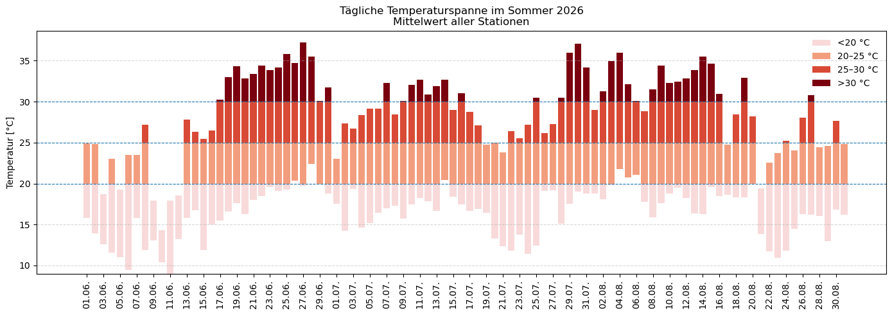
Figure 1) Daily temperature range from the 1st June 2026 – 31st August 2026. Average over all measurement sites in Winterthur.
Although a short cooling period followed, temperatures remained well above seasonal norms. July brought another extended period of warmth, and a second intense heatwave before temperatures gradually eased toward the end of the meteorological summer.
When the Nights Stay Warm
Hot days can be uncomfortable, but hot nights often pose a greater challenge. A tropical night is defined as a night during which temperatures never drop below 20°C. These nights are particularly important because they prevent buildings, streets, and even the human body from cooling down and recovering from daytime heat. The measurements from Winterthur reveal substantial differences across the city. Some monitoring locations recorded only two to five tropical nights during the summer, while the old town experienced more than fifteen. A remarkable contrast, meaning that residents living only a few kilometers apart may have experienced very different levels of heat stress. In cooler areas, open windows at night provided some relief. In warmer neighborhoods, even the night-time hours offered little respite.
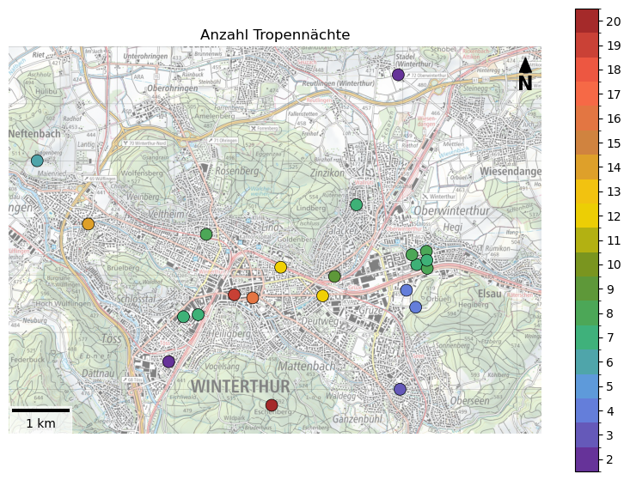
Figure 2) Number of tropical nights from the 1st June 2026 – 31st August 2026 (92 days) at each measurement site.
The map of tropical nights (Fig. 2) highlights a well-known urban phenomenon: the urban heat island effect. Buildings, roads, and paved surfaces absorb large amounts of solar energy during the day and release that heat slowly after sunset. As a result, densely built urban areas tend to remain warmer throughout the night than greener or less developed surroundings. The spatial pattern observed across Winterthur clearly reflects this effect. Locations in more densely urbanized parts of the city recorded the highest numbers of tropical nights, while sites with better ventilation, more vegetation, or proximity to open green spaces experienced significantly fewer. To understand what happens on the Eschenberg hill, check out the previous post.
More Than Just a Few Hot Days
This combination of hot days and warm nights is characteristic of prolonged heat events and can place significant stress on public health, infrastructure, and urban ecosystems. Extended periods without sufficient cooling can increase energy demand, reduce sleep quality, and exacerbate heat-related illnesses, especially among vulnerable populations such as older adults, young children, and individuals with pre-existing health conditions.
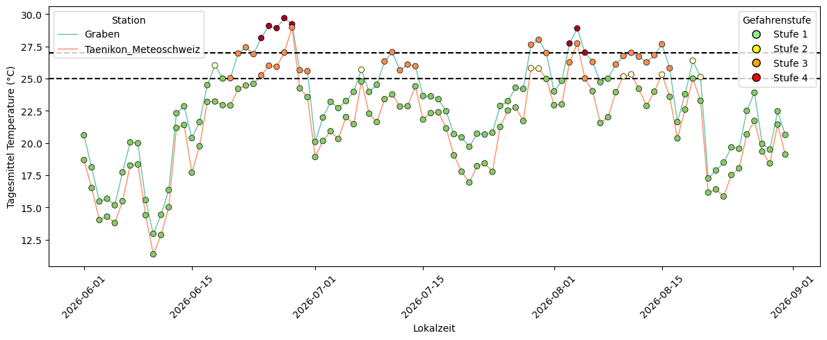
Figure 3) Time series of the daily mean temperature in Winterthur Graben and the closes MeteoSchweiz station in Tänikon. Symbols are colored based on their heat warning level. From 1st June 2026 – 31st August 2026.
MeteoSchweiz defines official heat warning levels. A comparison of the warning levels in the old town (Winterthur Graben) and the nearest reference station in Tänikon is shown in Figure 3. In Graben several periods reached the highest warning category, indicating conditions associated with elevated health risks. Rather than being isolated events, these warnings persisted for much of the three-month period.
One of the key lessons is that also extreme heat is not distributed evenly across a city. Local factors such as vegetation, building density, surface materials, and air circulation can strongly influence how people experience such conditions. The measurements demonstrate the value of dense urban monitoring networks. While a single weather station may capture the overall weather situation, it cannot fully reveal the differences between neighborhoods. Understanding where the hottest areas are located is essential for developing effective adaptation measures.
The summer of 2026 was more than a sequence of hot afternoons. It was a three-month period during which heat became a defining feature of daily life across Winterthur. The combination of repeated heatwaves, widespread tropical nights, and persistent heat warnings highlights how strongly cities can be affected by prolonged warm conditions.
As urban areas continue to adapt to a warming climate, detailed observations such as these provide an important foundation for understanding where heat accumulates, who is most affected, and how cities can become more resilient in the future.