Navigation menu
- Education
- Emissions & Air Quality
- Infrastructure & Services
- Meteorology & Climate
- News
- Physical Chemistry
- Projects
- The Team
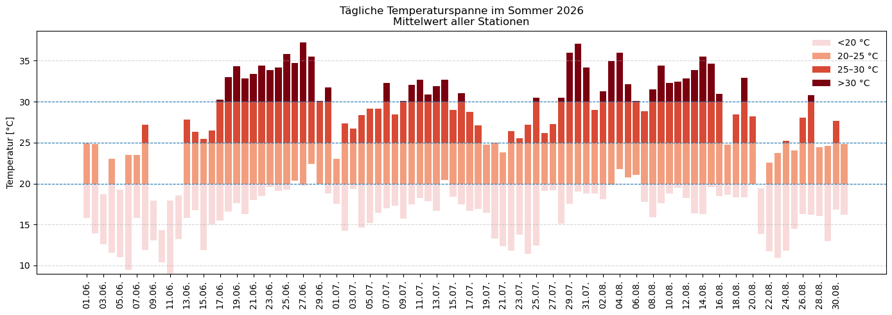
Like much of Europe, Winterthur experienced hot weather during the summer of 2026. During heatwaves, however, nighttime temperatures are just as important as daytime temperatures. When the air stays warm throughout the night, people have fewer opportunities to recover from the heat of the day.
To investigate nighttime temperatures in more detail, we measured four vertical temperature profiles, each extending up to 22 metres above the ground, during two particularly hot and calm nights. The measurements took place during two heat wave periods, on the nights of 24–25 June and 3–4 August.
Measurement setup
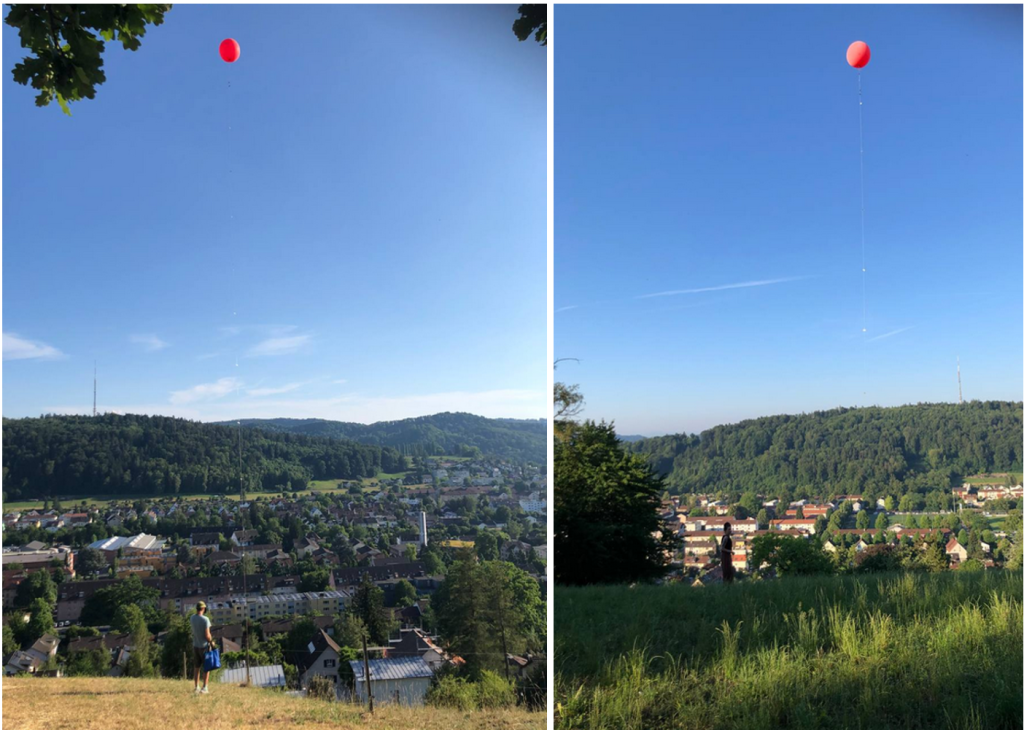
Measuring temperature profiles from the ground to a height of 22 metres requires a structure on which to mount the sensors. Installing poles of this height would have required considerable effort and permits, so we opted for a more lightweight alternative. We used Sensirion SHT43 demoboards, which measure temperature and humidity and weigh only 16 grams each. However, these sensors have no protection against rain or direct solar radiation making them only suitable for nighttime measurements under dry conditions. Their low weight made our setup possible: we attached 11 sensors to a nylon string and suspended the string from a large helium balloon.
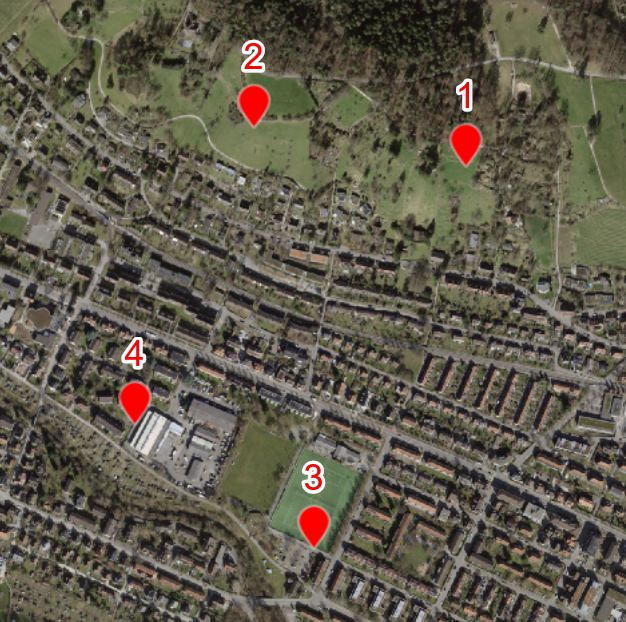
The tethered balloon approach has several advantages. It is relatively inexpensive, easy to set up and can be taken down quickly after the measurements. However, it also has limitations. We had to monitor the weather carefully, as measurements were only possible on dry nights with little wind. We also needed sufficient open space to ensure that a falling balloon or string would not cause damage. Having already selected Winterthur-Veltheim as an area of interest, we chose four measurement locations within the neighbourhood.
How did it go?
Our aim was to measure during hot, calm nights without precipitation. We quickly discovered one practical challenge: these nights often follow hot days. Setting up and installing the balloons in the afternoon was therefore considerably more exhausting than we had anticipated when planning the campaign during the cool winter months. However, despite our physical discomfort the set up went smoothly.
In the morning we arrived early to collect the sensors. Some of the ballons unfortunately lost quite a bit of helium during the night, which meant they could no longer support the full weight of the sensor string. Consequently, they sank by two to four meters. During the August campaign, one balloon met an even less fortunate end. Whether it lost too much helium or was pushed down by a gust of wind, it eventually became entangled in a tree and had burst by the time we returned in the morning.
What will we do with the data?
Winterthur is surrounded by hills, making it an interesting location to study nighttime cold-air drainage. As the ground cools after sunset, denser air can flow downhill and help ventilate urban areas. These flows may influence nighttime temperatures, but they can be difficult to measure directly.
This is why in addition to two fixed transects of temperature sensors at 2m above ground along the hillside we measured those temperature profiles. We hope that a measurement of the vertical structure of the Boundary layer can help us interpret our 2m data and help us better understand the interaction between vertical temperature structure, nighttime cooling and cold-air ventilation in Winterthur.